In mental health and medicine, terms like “syndrome,” “disease,” and “disorder” are often used interchangeably in everyday conversation. However, in clinical practice, each word carries a specific meaning that affects diagnosis, treatment, and communication between healthcare providers. At Lahore Rehab & Wellness Center, we believe understanding these distinctions empowers patients and families to engage more meaningfully in their care. This blog clarifies the differences.
A disease is a pathological condition of the body or mind that has a known cause, recognizable signs and symptoms, and a predictable course. Diseases are typically understood at a biological or physiological level. They are often measurable and have established diagnostic criteria.
Examples:
Key Features:
A disorder refers to a disturbance in normal function, often at the level of mental, behavioral, or physical systems. Unlike diseases, disorders may not have a single known cause or clear biological marker. They are often defined by a cluster of symptoms that cause clinically significant distress or impairment.
Examples:
Key Features:
A syndrome is a group of signs and symptoms that consistently occur together, suggesting a particular underlying condition or increased risk. However, the exact cause may not yet be fully understood. A syndrome is essentially a pattern that clinicians recognize, often before the specific disease mechanism is discovered.
Examples:
Key Features:
Alcohol-Induced Major Depressive Disorder is a disorder because it describes functional impairment (depression) directly caused by a specific substance (alcohol). The cause is known, but the condition is classified as a disorder due to its symptom-based diagnosis.
Wernicke-Korsakoff Syndrome is a syndrome because it refers to a specific cluster of symptoms (confusion, memory loss, coordination problems) caused by thiamine deficiency, often due to chronic alcohol use. The cause is known, but the presentation is as a syndrome.
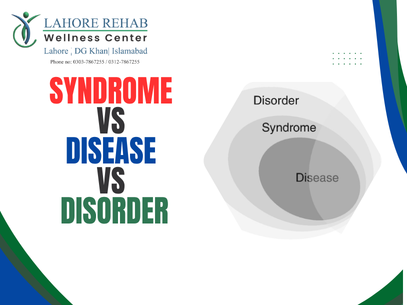
Neurocognitive Disorder due to Alzheimer’s Disease illustrates the hierarchy: Alzheimer’s is the disease (underlying pathology), and neurocognitive disorder is the disorder (the resulting functional impairment). The syndrome (dementia) is the observable pattern of symptoms.
1. Diagnosis and Treatment:
Understanding whether a condition is a disease, disorder, or syndrome guides clinicians in choosing appropriate diagnostic tests and treatment approaches. Diseases often have targeted treatments (e.g., antibiotics for bacterial infections). Disorders may require broader interventions (e.g., therapy and lifestyle changes). Syndromes may require treating the underlying cause or managing individual symptoms.
2. Prognosis and Communication:
Knowing the classification helps healthcare providers communicate realistic expectations. Patients and families benefit from clear explanations of what is known, what is uncertain, and what treatment can achieve.
3. Research and Classification:
These distinctions also matter in medical research. Scientists studying diseases focus on underlying mechanisms. Researchers studying disorders look at behavioral and functional patterns. Syndrome research often aims to identify common causes linking clusters of symptoms.
While “syndrome,” “disease,” and “disorder” are sometimes used loosely, they carry distinct clinical meanings. A disease has a known cause and biological mechanism. A disorder involves functional impairment with often complex causes. A syndrome is a recognizable pattern of symptoms that may or may not have a known cause. At Lahore Rehab & Wellness Center, we use these distinctions to provide precise, personalized care—addressing not just your symptoms, but the whole picture of your health.
Have questions about your diagnosis? Our team at Lahore Rehab & Wellness Center is here to provide clarity and compassionate care.
📍 PIA Road Branch, Lahore | 📍 Nawab Town Branch, Lahore | 📍 Dera Ghazi Khan Branch